
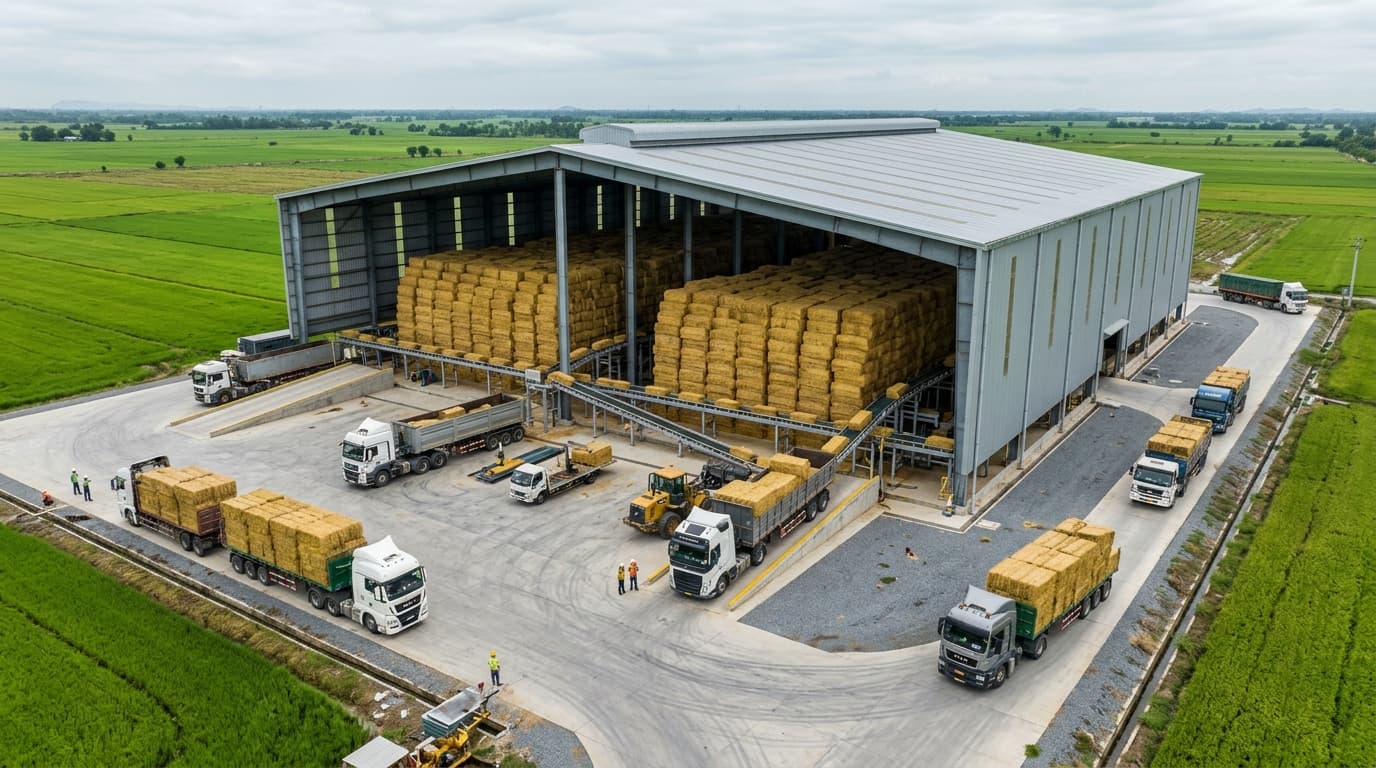
Building resilient supply chains for agricultural biomass.
Our feedstock architecture combines regional aggregation logistics, automated quality testing, and multi-year miller partnerships to secure continuous biomass supplies without competing with food security.
Transforming agricultural residues into dependable industrial inputs.
Industrial processing requires rigid predictability in feedstock moisture, biogenic precursor yield, and supply security. Our aggregation network contracts directly with regional rice mills and agrarian Farmer Producer Organizations (FPOs).
By creating a reliable, transparent monetization channel for rice husk and crop residues, we transform regional waste into bankable economic value while eliminating the seasonal air pollution associated with crop residue burning.
Regional Catchment Hubs (50–100 km Radius)
Centralized aggregation hubs established in close proximity to high-density rice milling clusters, minimizing transport carbon footprint and haulage costs.
Weatherproof Covered Storage & Thermal Safety
High-clearance ventilated hangars equipped with continuous temperature probes, active aeration tunnels, and automated spark/dust explosion suppression systems.
NIR Moisture Verification & Quality Gates
In-line Near-Infrared (NIR) sensors analyze incoming deliveries at weighbridges. Husk with moisture >12% is routed through solar drying tunnels before storage.
Direct Miller & Farmer Producer (FPO) Contracts
Long-term guaranteed off-take contracts with regional rice millers and Farmer Producer Organizations, injecting steady income into rural farming economies.
Upstream Aggregation
Rice husk and field residues are collected from regional millers, preventing hundreds of thousands of tons of open-air agricultural burning each harvest season.
Industrial Refining
Biomass is thermally calcined and refined to synthesize ultra-pure Green Silicon For Chips (9N purity / 99.9999999%), while organic residues generate biomethane and process steam.
Downstream Reintegration
Digestate co-products are pelletized into Fermented Organic Manure (FOM) and delivered back to farmers, replenishing soil carbon and closing the loop.